
Oil Surge Relay (OSR) of Transformer: Working Principle, Protection, Tripping Causes Testing
An Oil Surge Relay (OSR) is a protective device used in oil-filled transformer On Load Tap Changer (OLTC) systems. It detects abnormal oil flow associated with certain internal OLTC faults and operates an electrical contact that can initiate transformer tripping.
Oil Surge Relays are important components in power transformers, electrical substations and industrial installations where OLTC protection is required.
In this technical guide, we explain the Oil Surge Relay working principle, function, construction, installation, tripping causes, troubleshooting, testing procedure and differences between an Oil Surge Relay and a Buchholz Relay.
We also cover OSR-I relay specifications and how to select a suitable replacement.
1. What Is an Oil Surge Relay (OSR) in a Transformer?
An Oil Surge Relay, abbreviated as OSR, is a protection device typically installed in the oil pipe connecting the transformer OLTC compartment to its dedicated conservator.
The relay monitors oil movement through the connecting pipe.
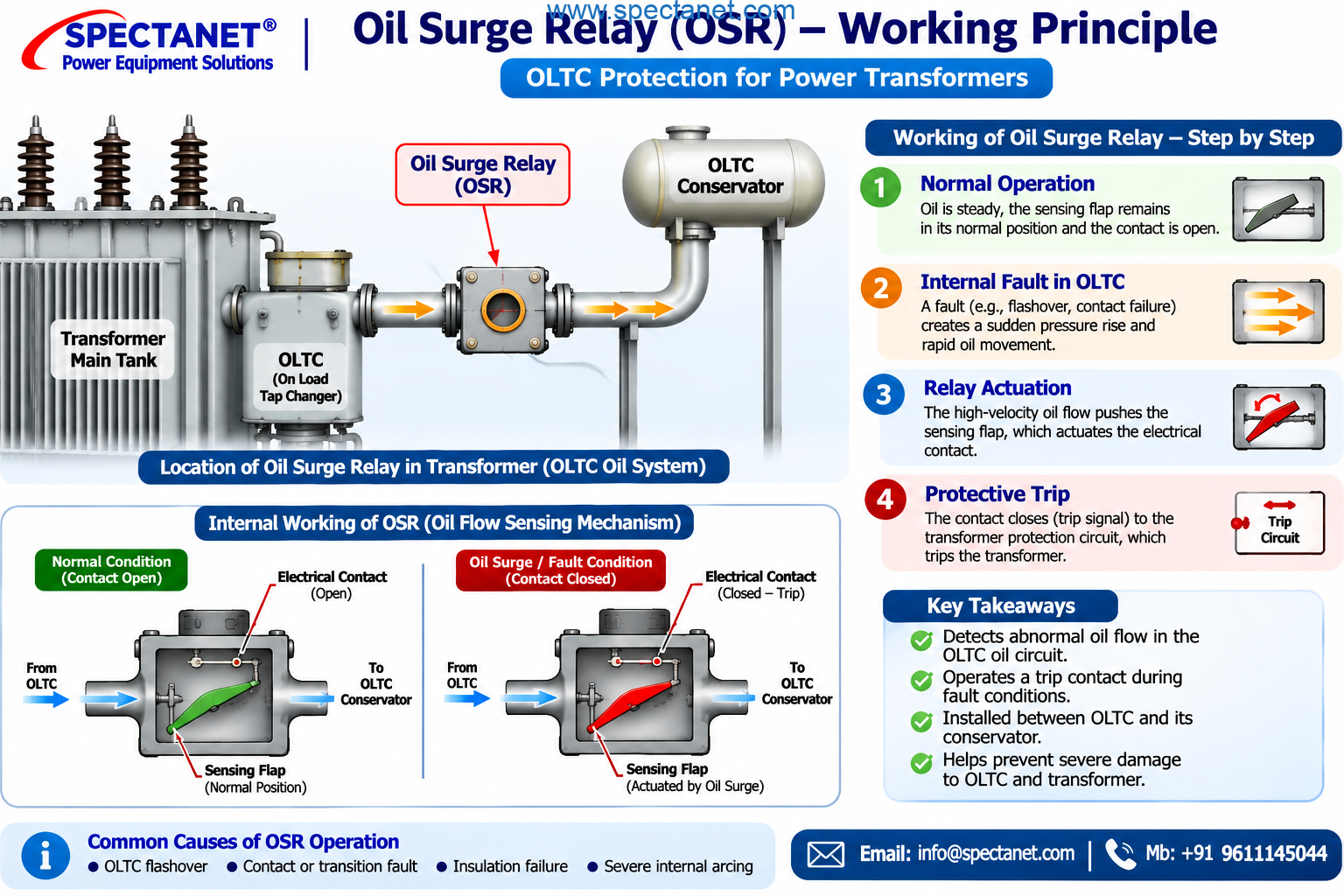
During normal transformer operation, the oil-flow sensing mechanism remains in its normal position. When an internal fault causes a sufficiently strong oil surge, the sensing element moves and operates the relay contact.
This contact can be connected to the transformer protection circuit to initiate tripping.
The primary purpose of the Oil Surge Relay is to detect specified abnormal oil-flow conditions and help limit damage resulting from internal OLTC faults.

2. Why Is an Oil Surge Relay Required in an OLTC?
An On Load Tap Changer (OLTC) regulates transformer output voltage by changing winding tap connections while the transformer remains energized.
An OLTC may contain moving contacts, selector mechanisms, diverter switches, transition resistors and mechanical operating components.
Depending on the OLTC design, these components operate within dedicated oil compartments.
Potential internal faults include:
- Electrical flashover within the OLTC compartment.
- Insulation breakdown.
- Severe contact damage.
- Faults involving transition resistors or switching components.
- Internal short-circuit conditions.
- Mechanical failures that result in abnormal electrical or oil-flow conditions.
Certain faults can generate rapid pressure changes and cause oil to move toward the OLTC conservator.
The Oil Surge Relay detects the resulting abnormal oil flow when its operating threshold is reached.
Important: The OSR does not directly detect every OLTC defect. Its response depends on the oil-flow conditions produced by the fault and the relay's operating characteristics.
3. Oil Surge Relay Working Principle
The working principle of an Oil Surge Relay is based on detecting abnormal oil-flow velocity.
Step 1: Normal operation
During normal transformer operation, the oil-flow sensing mechanism remains in its normal position.
The relay is designed to avoid operation under the oil-flow conditions permitted by its manufacturer.
Step 2: Internal OLTC fault
An internal electrical fault may produce rapid pressure changes within the OLTC oil compartment.
This can cause insulating oil to surge through the connecting pipe toward the conservator.
Step 3: Movement of the sensing mechanism
When the oil flow exceeds the relay's specified operating threshold, the internal sensing element moves.
In certain OSR designs, the sensing mechanism uses a mechanically operated flap.
Step 4: Electrical contact operation
Movement of the sensing mechanism actuates the electrical switching contact.
The contact changes state and provides a signal to the associated transformer protection circuit.
Step 5: Transformer protection operation
Depending on the protection scheme, the relay signal can initiate tripping of the relevant transformer circuit breakers.
This isolates the equipment and helps limit further damage.
Step 6: Inspection after tripping
After OSR operation, the transformer and OLTC must be investigated before re-energization.
The relay should not be reset and the transformer returned to service without identifying and addressing the cause of operation.
4. Oil Surge Relay Installation Diagram and Location
The Oil Surge Relay is normally installed between the OLTC oil compartment and its associated conservator.
A simplified arrangement is:
OLTC Oil Compartment → Oil Surge Relay → OLTC Conservator
The relay must be installed in the correct orientation and oil-flow direction specified by the manufacturer.
Important installation requirements include:
- Correct mounting position and inclination.
- Correct oil-flow direction.
- Suitable pipe diameter.
- Matching mounting flanges and gaskets.
- Proper electrical contact connections.
- Suitable oil filling and venting arrangements.
- Accessibility for inspection and maintenance.
The OLTC oil system and main transformer oil system are generally kept separate where required by the transformer design.
An Oil Surge Relay should not be installed or replaced based only on visual similarity.
5. Main Components of an Oil Surge Relay
Oil Surge Relay construction varies between manufacturers, but commonly includes the following components.
Relay body
The relay body houses the internal mechanism and provides the oil passage.
Oil-flow sensing element
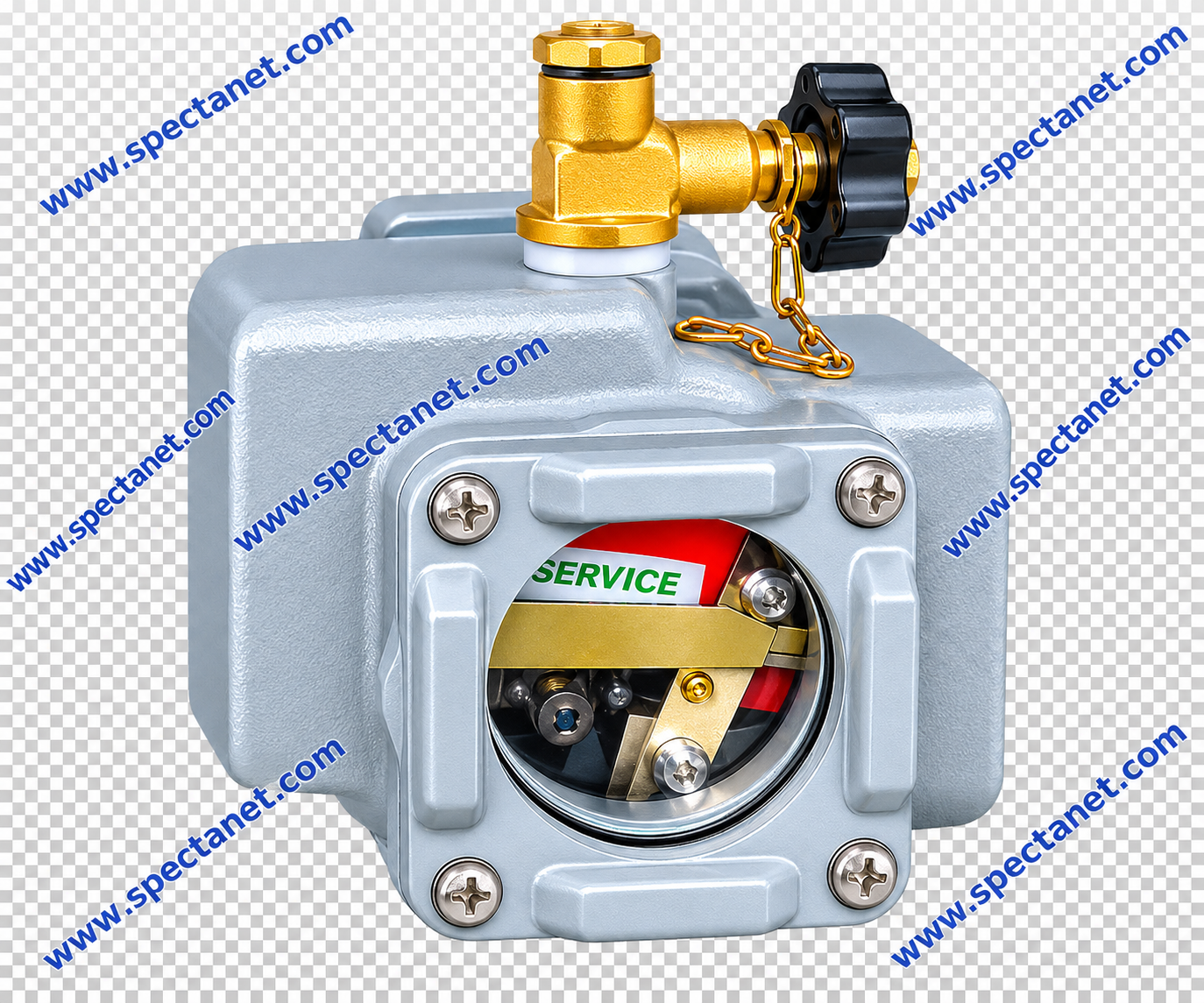
The sensing element responds to abnormal oil movement. Some designs use a flap-type mechanism.
Electrical switching contacts
These contacts provide an electrical output to the transformer protection system.
Inspection window
Certain models include an inspection window for observing the internal mechanism.
Mounting flange
The mounting flange connects the relay to the OLTC oil pipework.
Test and vent fittings
Depending on the design, the relay may include fittings for approved testing, venting or maintenance procedures.
6. Oil Surge Relay Tripping Causes
Why does an Oil Surge Relay trip?
An OSR trip indicates that the relay or its associated protection circuit has operated. The cause must be investigated carefully.
Possible causes include:
- Internal OLTC flashover: An electrical fault may produce abnormal pressure and oil movement.
- Insulation failure: Deterioration or breakdown of insulation may contribute to an internal fault.
- Diverter switch faults: Severe damage to contacts or switching components can result in abnormal fault conditions.
- Abnormal oil movement: Hydraulic disturbances outside the relay's permitted operating conditions may cause operation.
- Incorrect installation: Improper orientation or an unsuitable relay setting may contribute to unwanted operation.
- Mechanical malfunction: Damage or sticking of the sensing mechanism may affect relay operation.
- Protection circuit problems: Wiring or auxiliary circuit faults may produce a trip indication that requires electrical investigation.
An OSR trip does not, by itself, identify which of these conditions occurred.
7. Oil Surge Relay Tripped? Troubleshooting Checklist
An Oil Surge Relay trip should be treated as a potentially serious transformer protection event.
Before any inspection, follow the approved isolation, lockout and site safety procedures.
A. Check protection records
Review the protection relay event logs, annunciator indications and sequence-of-events records.
Determine whether the OSR operated alone or together with other transformer protection devices.
B. Inspect the OLTC compartment
Qualified personnel should inspect the OLTC according to the manufacturer's instructions.
Check for signs of abnormal contact wear, overheating, insulation damage, mechanical defects or internal arcing.
C. Check transformer oil condition
Oil testing can provide useful information about the condition of the OLTC oil.
The following tests may be appropriate.
Breakdown Voltage (BDV) Test
The BDV test measures the dielectric breakdown voltage of insulating oil under specified test conditions.
A low result may indicate contamination or other conditions affecting the oil's dielectric performance.
BDV testing alone does not establish the cause of an OSR trip.
Moisture Content Test
Moisture content is commonly measured in parts per million (ppm).
Excessive moisture can adversely affect the dielectric properties of transformer insulating oil.
However, moisture detection alone does not prove that an OSR operated because of an internal fault.
Dissolved Gas Analysis (DGA)
DGA measures gases dissolved in insulating oil.
Depending on the oil system and equipment design, the results can help identify possible thermal or electrical abnormalities.
DGA results must be interpreted using the appropriate standards and OLTC-specific diagnostic guidance.
Oil Level Inspection
Check the oil level in the associated conservator and investigate any abnormal reduction.
Also inspect for leakage or other conditions affecting the oil system.
D. Inspect the breather
Where a conservator breather is fitted, inspect the silica gel condition and associated sealing arrangement.
A saturated or defective breather can contribute to moisture ingress.
However, a saturated breather is not, by itself, proof of the cause of an OSR trip.
E. Check the Oil Surge Relay
Inspect the relay for visible mechanical damage, leakage or abnormal condition.
Verify the electrical contact circuit using the manufacturer's approved test procedure.
F. Investigate before restarting
Do not bypass the OSR protection circuit or re-energize the transformer until the cause has been assessed and the equipment is cleared for service by authorized personnel.
8. Difference Between Oil Surge Relay and Buchholz Relay
An Oil Surge Relay and a Buchholz Relay are both used in transformer protection, but their typical functions differ.
| Parameter | Oil Surge Relay (OSR) | Buchholz Relay |
|---|---|---|
| Application | OLTC compartment protection | Main transformer tank protection |
| Typical installation | OLTC-to-conservator pipe | Main tank-to-conservator pipe |
| Operating principle | Abnormal oil-flow detection | Gas accumulation and sudden oil-flow detection |
| Gas accumulation alarm | Not normally its primary function | Commonly provided |
| Typical output | Trip contact | Alarm and trip contacts |
| Protected equipment | On Load Tap Changer | Main transformer oil system |
A Buchholz Relay is commonly used in conservator-type oil-filled transformers to detect certain internal faults through gas accumulation and oil movement.
An Oil Surge Relay is primarily intended to detect abnormal oil flow associated with an OLTC oil compartment.
The devices are not automatically interchangeable.
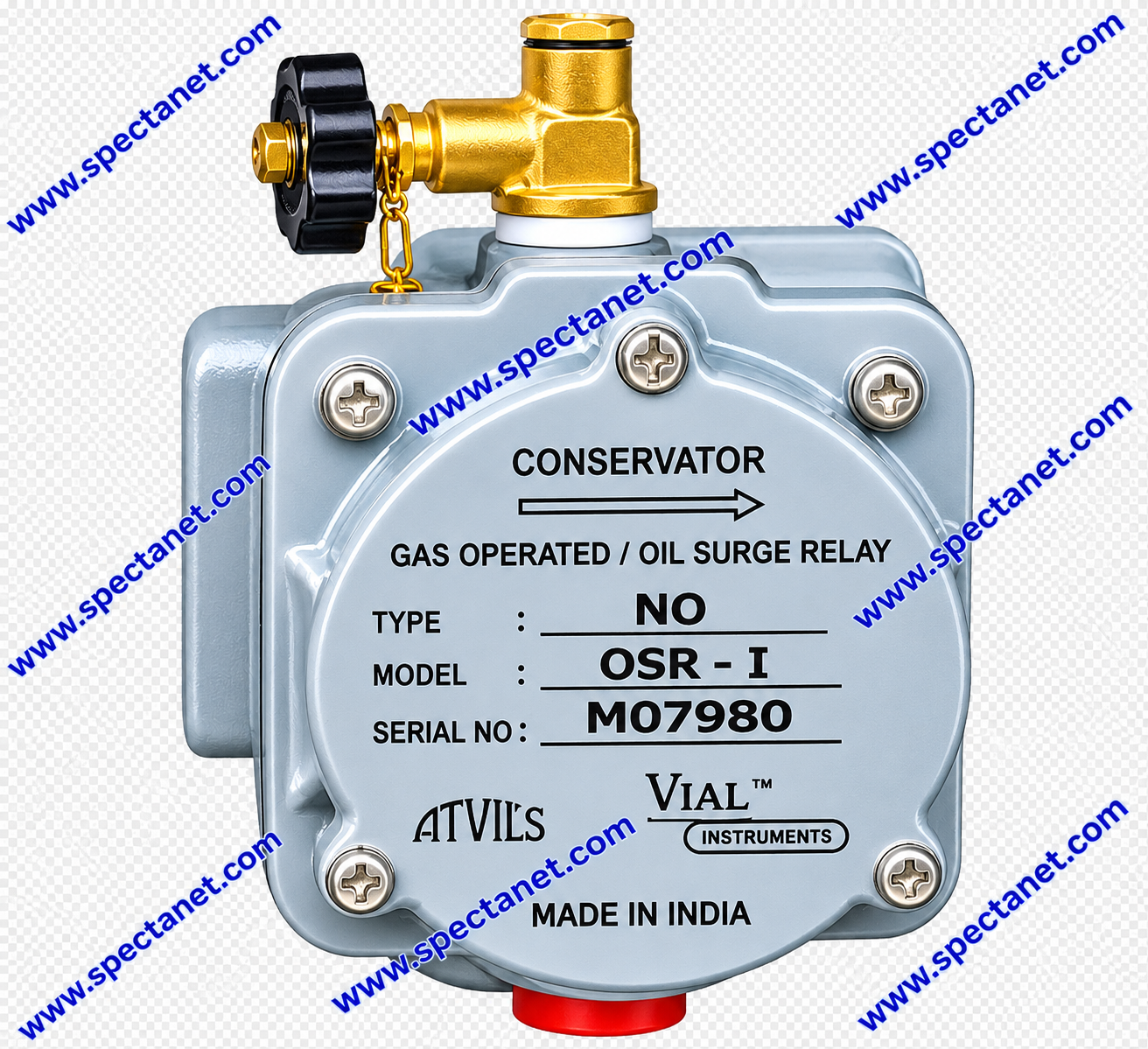
9. Oil Surge Relay Technical Specifications – OSR-I Model
For replacement applications, it is essential to confirm the dimensions and electrical characteristics of the existing relay.
The following details are listed for the OSR-I product offered through Spectanet.
| Parameter | Specification |
|---|---|
| Product | Transformer Oil Surge Relay |
| Model | OSR-I |
| Application | Transformer OLTC Protection |
| Overall Length | 180 mm |
| Overall Width | 120 mm |
| Overall Height | 155 mm |
| Mounting Flange | 76 × 76 mm |
| Mounting P.C.D. | 72 mm |
| Mounting Holes | 4 × M10 |
| Pipe Bore | Ø25 mm |
| Inspection Window | Provided |
| Type Marking | NO |
Note: These are reference dimensions. The actual flange-hole geometry, operating threshold, electrical contact ratings and installation compatibility must be verified before purchasing or manufacturing a replacement.
Buy Transformer Oil Surge Relay OSR-I
Looking for a replacement Oil Surge Relay for your transformer OLTC?
Spectanet supplies transformer OLTC spare parts and protection-related components for maintenance and replacement applications.
VIEW TRANSFORMER OIL SURGE RELAY OSR-I – PRODUCT DETAILS & PRICE ENQUIRY
10. Oil Surge Relay Testing and Maintenance
Oil Surge Relay maintenance helps verify the condition of the relay and its associated protection circuit.
Typical maintenance activities include:
- Visual inspection for damage and oil leakage.
- Inspection of mounting flanges and gaskets.
- Checking electrical terminal connections.
- Verification of contact operation using the approved test facility.
- Inspection of the sensing mechanism where permitted.
- Checking the protection circuit according to site procedures.
- Verification of the operating threshold when required using appropriate manufacturer-approved equipment.
The exact test procedure depends on the relay design.
A continuity test alone cannot confirm the oil-flow operating setting of an Oil Surge Relay.
Any functional or trip-circuit testing must be carried out by qualified personnel under an approved procedure.
11. How to Select an Oil Surge Relay for Transformer Replacement
Before purchasing a replacement Oil Surge Relay, confirm:
- Existing relay manufacturer and model.
- Transformer manufacturer and OLTC type.
- Nominal pipe bore.
- Mounting flange dimensions.
- Mounting-hole arrangement and P.C.D.
- Bolt or threaded-hole specifications.
- Overall dimensions and available installation clearance.
- Electrical contact configuration and ratings.
- Required oil-flow operating threshold.
- Insulating oil type and operating conditions.
- Required quantity.
Where possible, provide photographs of the existing relay, its nameplate and the mounting arrangement.
Correct mechanical dimensions alone do not establish that a relay is suitable for the transformer protection system.
12. Oil Surge Relay Price in India
The Oil Surge Relay price in India depends on the model, manufacturer, mounting dimensions, operating characteristics, electrical contact requirements and quantity.
For replacement enquiries, customers should provide the existing relay details to obtain a suitable quotation.
Spectanet supplies transformer OLTC spares and related components for industrial transformer maintenance and replacement requirements.
Check Oil Surge Relay OSR-I Product Details and Request a Quotation
13. Frequently Asked Questions About Oil Surge Relays
What is the full form of OSR in a transformer?
OSR stands for Oil Surge Relay, a protection device commonly used in oil-filled transformer OLTC systems.
What is the function of an Oil Surge Relay?
It detects specified abnormal oil-flow conditions and operates an electrical contact connected to the transformer protection circuit.
Where is an Oil Surge Relay installed?
It is typically installed in the oil pipe connecting the OLTC compartment to its associated conservator.
How does an Oil Surge Relay work?
When abnormal oil flow exceeds the relay's operating threshold, the internal sensing mechanism actuates an electrical contact.
Why does an OSR trip?
An OSR may operate due to abnormal oil movement associated with an OLTC fault. Mechanical, installation and electrical circuit issues must also be investigated.
What tests should be performed after an OSR trip?
Depending on the fault investigation, testing may include oil BDV, moisture content, DGA, OLTC inspection and verification of the protection circuit.
Is an Oil Surge Relay the same as a Buchholz Relay?
No. An Oil Surge Relay typically protects an OLTC oil compartment, while a Buchholz Relay commonly protects the main transformer tank.
Can a transformer operate without an Oil Surge Relay?
Where an OSR is part of the specified protection arrangement, it should not be bypassed or omitted. Any modification requires appropriate engineering approval.
What is the OSR-I relay?
OSR-I is a model designation used for an Oil Surge Relay. Its exact suitability depends on the manufacturer's specifications and the transformer installation.
Where can I buy an Oil Surge Relay in India?
You can contact Spectanet for Oil Surge Relay OSR-I product details, replacement enquiries and quotations.
Buy / Enquire for Transformer Oil Surge Relay OSR-I
14. Conclusion
The Oil Surge Relay (OSR) is an important protection device for oil-filled transformer On Load Tap Changers.
It responds to abnormal oil-flow conditions associated with certain internal OLTC faults and can initiate transformer tripping through the protection circuit.
Understanding the Oil Surge Relay working principle, correct installation, tripping causes and testing requirements is essential for transformer protection and maintenance.
When selecting a replacement relay, both mechanical and electrical compatibility must be verified.
Buy Transformer Oil Surge Relay OSR-I
Looking for an Oil Surge Relay for transformer OLTC protection? Contact Spectanet for specifications, availability and quotation.
View Product & Request PricePhone / WhatsApp: +91 9611145044